


Adjusted Return Indices video

Insert heading text
with an optional subtitleWhat is an Index?
An index measures the performance of a basket of securities, such as stocks or bonds, that represent a specific segment of the market. Indices can be broad-based, capturing large groups of stocks or bonds and representing a broader market, or more more concentrated, consisting of a smaller number of securities or focusing on a particular industry or market segment.
What is a total return Index?
A Total Return Index (“TR Index”) measures the overall performance of the constituents, reflecting both the increase or decrease in the constituent prices and income generated from dividend distributions (in the case of an equity index) and interest payments (in the case of a bond index). A TR Index assumes all such dividend payments to be reinvested in their constituents.
What is a price return Index?
A Price Return (“PR”) Index measures performance of the constituents, reflecting the increase or decrease in the prices of the constituents and excluding dividends or interest payments.

What is an Adjusted Return (AR) Index?
Adjusted Return (AR) Indices are commonly used in structured notes and became prevalent in Canada in the 2020s. They are comparable to traditional Price Return Indices, except they deduct a pre-defined “synthetic dividend”, also known as the “AR Factor”, from the TR Index. The AR factor is usually deducted daily, as opposed to actual dividends which are paid periodically (quarterly, annually, etc.), which could result in some short-term divergence between the AR and PR Indices, all else equal.

An AR Index may perform differently from a comparable PR Index if the AR Factor diverges from the actual dividends paid by its constituents. Investors should consider the magnitude of this difference as well as whether they expect the dividends of the constituents to grow over time.
Consider the following 1-year example, which illustrates how changes to the underlying asset’s dividend can affect the AR Index's performance. We will assume that:
- The PR Index begins and ends at 1000*
- The AR Index has a synthetic dividend of 50 Index points
- The AR, PR and TR Indices have the same constituents, weights and Index rules
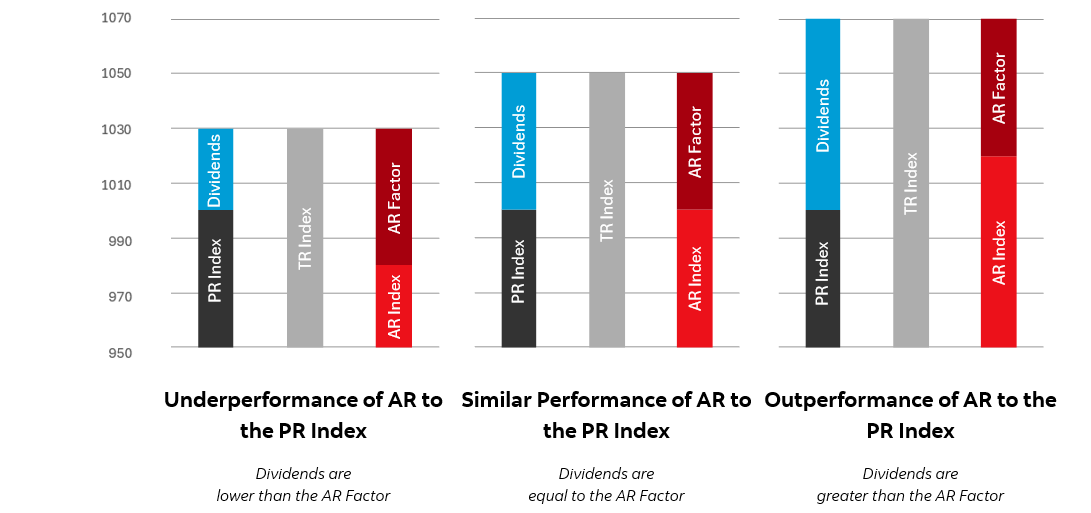
| PR Index Level | 1,000 | 1,000 | 1,000 |
| Dividends Paid (in Index Points) | 30 | 50 | 70 |
| TR Index | 1,000 + 30 = 1,030 | 1,000 + 50 = 1,050 | 1,000 + 70 = 1,070 |
| AR Index Level (50 Point AR Factor) | 1,030 - 50 = 980 | 1,050 - 50 = 1,000 | 1,070 - 50 = 1,020 |
*The assumption that the PR Index Level remains the same from start to finish during a one year term is for illustrative purposes only to highlight the impact of the AR Factor, with no other variables changing. The levels of any applicable Index are expected to fluctuate higher or lower after the start date, which will impact the performance of an AR Index.
Fixed Point AR Indices versus Percentage AR Indices
AR Indices fall into two categories: Percentage or Fixed Point.
In Fixed Point AR Indices, the AR Factor is fixed throughout time and does not change based on the level of the TR Index. Fixed Point AR Indices are expected to outperform, all else equal, their respective PR Indices when the dividends declared by their underlying constituents are increased. Conversely, should the constituents of the Index cut their dividends, the AR Index will underperform.
In Percentage AR Indices, the AR Factor is a percentage of the index level and can therefore vary over time based on the level of the TR Index. Percentage AR Indices are expected to outperform, all else equal, their respective PR Indices if the dividend yield of the PR Index is higher than the AR Factor. Percentage AR Indices are therefore affected by not just the dividends declared by the index constituents, but also the index level.
In times of stable markets, both methods frequently yield similar results, but they may also show more significant differences depending on how much the underlying index level moves. Assuming the two AR Indices have a similar AR Factor at inception while all other factors remain constant, an index with a Fixed Point AR Factor is expected to outperform one with a Percentage AR Factor in rising markets. This is due to the fixed point deduction representing a smaller proportion of the index’s total value as it increases. Conversely, in declining markets, Fixed Point AR Indices are expected to underperform their Percentage AR Factor counterparts due to the fixed point deduction representing a larger proportion of the index’s total value as it decreases.
Additional considerations
AR Indices can introduce additional complexity into the investment decision of structured notes, especially in cases where the AR Factor differs significantly from the dividends of the underlying constituents of the index. A larger AR Factor will usually improve the pricing terms of a structured note (higher participation rates/contingent coupons/fixed returns, etc.), all else being equal, but also introduces higher risks, including lower expected payout of the note, higher probability of missed coupon payments and a higher probability of capital loss for principal at risk structures. Some underlying assets, especially those with uncertain or inconsistent track records of paying dividends may not be appropriate candidates for AR Indices.
Investors should consult their investment advisors and fully consider all the information set out in the offering documents before making any potential investment in structured notes. Investors should evaluate the risks described under the “Risk Factors” section in the offering documents.
If you are an investment professional looking to learn more about AR Indices or about Scotiabank’s structured notes including current offerings, please speak with your Scotiabank representative. If you are an investor, please reach out to your investment advisor.
