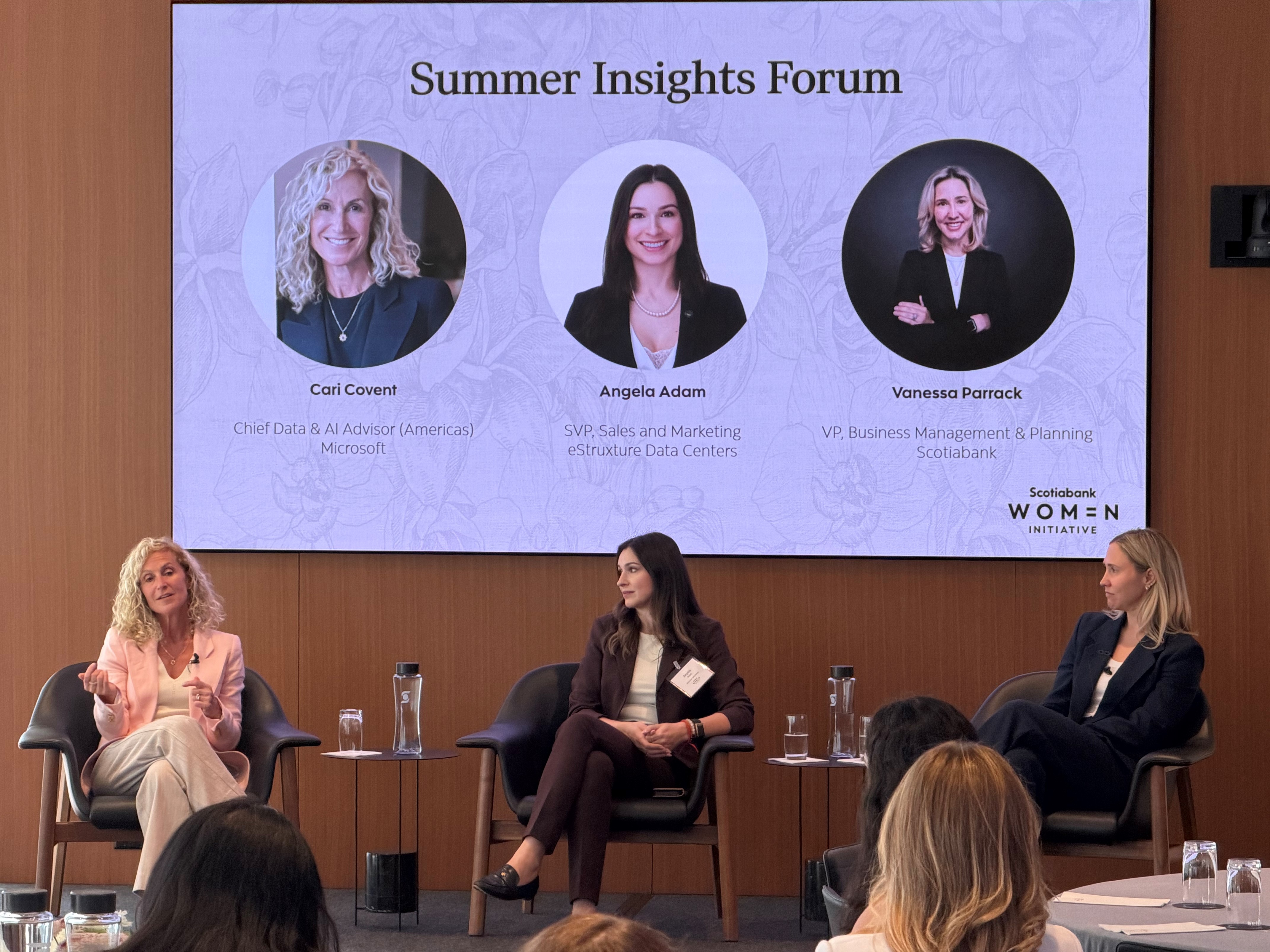
Vanessa Parrack: I've had a couple conversations with these women leading up to this, and every time I learn something new about them and about what they do and, and about the topic of AI.
We talked a little bit before about, you know, everyone talks about this technology shift, but it's also equally, if not more, where we are now a mindset shift. So, could you share a little bit about how you've seen that evolve, and for the leaders in the room, how to think about what that shift means to be successful using and deploying AI?
Cari Covent: Some of the things that are, you know, really important as a leader, that I think are really important, that people need to start to shift is... their curiosity. So as a leader, you would often go into a room, you would have been given a whole bunch of briefs before you go into the room, you would synthesize.
You're really there as that decision-maker based on the meeting. What's changing now is you have an opportunity to use AI to not just ask questions of the people in the room, but also to ask questions of the AI of that material before you go into the room. So, it becomes essentially a challenger for you to really test out, does this make sense, and feed you with information that you can then ask the people in the room. So, I think curiosity is one.
The second one is communication. So as leaders, as anyone really, it's really important that we're talking about how we're using AI personally, professionally, and what we are changing to actually scale it and to create value. And that communication has to start from the top down, and people need to understand that there's an experimentation piece of this, and when you think about the mindset shift, no one has all the answers right now.
And so, the idea of failing, now, you know, obviously it's a bank, so you have to fail within the guardrails that you put into place. But failing and then talking about, "I tried this, it didn't work. I tried this, and it did work." So, I would say curiosity, communication, and then the third one that I like to think about is collaboration.
And so, there's the collaboration with the AI. So, if you think about agents that are now sort of sitting beside you and can help you get to a decision more quickly. But then also collaboration, where AI is the most successful is when it's scaling horizontally across an organization. And so, the collaboration, the breaking down of these silos and vertical business units to have that sort of shared systemic change using AI is really important, and as people, in order to accomplish that we need to collaborate.
Angela Adam: Just to add, I picked up on a few things that Cari said. As a leader, you should be able to, you know, be able to test and potentially fail and talk about it, and I think we need to be ready. We don't need to be data scientists. We don't need to know everything, but we need to be ready enough to start, and we need to start now.
So, what we need to do, we need to be able to ask the right questions, right? What data are we using? Who's responsible? Who's mapping out the workflow? What problem are we trying to solve? What happens if it succeeds? What happens if it fails? What is the cost? Whether it succeeds or fails, what's the cost in terms of time, money, and effort, and trust? Because that could be a big issue if you lose the trust of your employees. That's probably going to be one of the biggest hurdles.
Another thing that I saw leaders just have issue was treating AI adoption as an IT project.
You're taking this project and you are handing over to your technical team. There's a pilot, and then you pop back up when the pilot is done and decide if, whether it works, it's not that way with AI. Because it's not an IT project, it really is a business transformation, because that's how we need to look at it, right? Not bolt on things onto old processes. We need to map out the process according to what we're trying to achieve with AI, not the other way around, because you don't want just incremental growth.
So, when we look at it as a project, then it's probably doomed to fail. You need to know, again, the data. Do you have the right mindset? Do you have the right people? Where curiosity is very important. I think that's how we picked our AI adoption champions.
Do you have enough compute? Because this is the world that I come from. Sometimes people underestimate this. Like, do you have the right machines? Where are you going to run your workloads? These are all questions that, as leaders, we own when we unleash an AI adoption project.
So again, it's not just about the tool. It's not about just handing it over to another group. It's owning end to end. This is next level business transformation.
VP: What advice would you give this group of leaders in terms of how do you identify what maybe a good AI opportunity is versus what should stay, you know, human-led?
CC: Think about it in terms of not what can you automate or what, what can you apply AI to, but truly what should you apply to it. And I think there's an important aspect of that, because not everything is going to be solved through AI. And so, there are elements, in my view, of every workflow in an organization that could have AI as an enabler but also working alongside the humans.
And what's evolving right now, and it's still early days, is this concept of right now everyone's talking about jobs and, you know, AI is going to replace all of these jobs. And so, what we're starting to see is this idea of new jobs that are emerging. So, if you think of, a workflow and areas where there's now AI, it doesn't necessarily mean that those people are completely displaced and out of a job. It's what new skills can we teach them that are going to add value and create value to the organization?
And so, part of the value creation challenge is not just what's the value that you can get out of the AI that you've now integrated into the workflow, but what value is getting created now out of these new roles that are coming to life that you never could have done before. And so, it's almost like this, this sort of dual stream of thinking through an operating model where you have agents that are completely, you know, doing a lot of the manual, repetitive tasks.
You've got people that are working alongside agents where you absolutely need humans in the loop depending on what it is that they're trying to, what problems they're trying to solve for. And then you've got humans, like this should only be done by a human. Think about, you know, in law, for example, if you have a litigation lawyer who's going to court, that's not being done by an AI agent.
How they get there though in their work stream might be. They might have got that help, but they're the ones that are showing up and, you know, working on behalf of their client to accomplish a specific outcome.
So, people, in my view, have never been more important, and the opportunity for them becomes, as leaders, exponential, and I think it's on us to start to reimagine what the workforce could look like. That's not easy.
VP: How do you move from experimentation to true transformation? And you mentioned value. How do you know when you're realizing actual value? Like, when do you know what to pursue from experiment to business transformation? What needs to be true?
CC: I was actually with an organization a couple of days ago, and they were talking to me about what they're doing with AI and I said, "Well, how are you measuring success?" And it was the CEO and he said, "Well, I don't know." And I said, "Okay, well, you shouldn't be doing AI for the sake of AI."
So, there's employee productivity, fine. That will be hard to measure. So, you know, whether it's Copilot, whether it's, you know, Gemini, whatever it is that you use for your employees, that's great. But then there's AI that truly is transforming workflows or helping to enable that, and if you haven't identified upfront what those measurements are, then it is going to be a great pilot, people are going to say, "Wow, that was awesome." And it is never going, I shouldn't say never, but it is unlikely that it is going to get the capital to actually move into production. And I can tell you as an early... I would say when I was leading AI and data at Canadian Tire, we were early adopters.
We had so many pilots that never went anywhere. And it was because we hadn't really landed on what the economics of AI need to be and got the executives' mind share into how we were going to measure that success.
And so having, you had talked a little bit, Angela, about sort of prioritizing, having a way to prioritize your use cases or your work streams based on the metrics, and then moving fast to deploy, measure, iterate, park if you need to, learn from it and move on, or move into production.
VP: You mentioned "what's the problem we're solving for?" And I think if you walk in there with the problem and already think about benefits, you have to, problem, what's the solution, then match it with the benefits and costs and go from there. But I think it's a different way we have to think about realizing value that we haven't done before.
CC: And I'll add one more thing to the problem statement, which is if it's a problem that is worth solving by more than one executive, or by more than one business unit, then it's probably a problem that is, you know, worth solving for the organization and will get the mind share of the people that actually need to be part of it to make it into production.
And so, if it's like, for example, if you were a telco, and we know how competitive the telco market here is in Canada, and customer churn is a big concern of yours, and it costs you hundreds of millions, if not, you know, a billion dollars a year potentially. That's a problem that every executive in the organization is thinking about.
So therefore, when you start to thinking of, think about how do you, what would be a great AI work stream or what would be a great AI use case? Customer churn would be something, because every, it will be important to every executive because it's important to all the customers, because it's important to the employees, and because it's important to their stock price.
So, those are things that as you, as we talk about horizontal, that ownership, that accountability, and that sort of consistency across the organization is very important.
VP: Big accelerator. We hear a lot about, "Oh, in the future you won't manage people, you'll only manage agents." And whether that's true or not, we'll see.
Could be. But what are the skills of the future? We both said it earlier too, people is the constant and the thing that actually becomes more and more important. But when we think about the leaders here or the teams that you lead, what type of skills or reskilling or how can we lead and support the sort of next generation and support ourselves in terms of what do we need to be successful?
What skills do we now need to hone in on to really accelerate AI?
AA: One of the things that we are very keen on in making sure that we don't let the gap widen between the employees that are very excited and are embracing AI and the skeptics. We want to make sure not only that they have access, similar access to the tools, but they also have the similar mindset shift and I understand, you know, the different, the different camps and make sure that we have at some point, and we train, and we have at some, some point a baseline of basic knowledge for everyone.
We don't risk, you know, employees using AI that's not that's not approved or in a risky way, all of that. So, we start there. Everybody needs to understand where the company's going from an AI perspective, and we need to try and get them excited with regarding our vision and not, again, not create any gaps. If we're going to adopt an AI strategy, I think reskilling comes with it, right? And our view is we're going to make AI and AI agents as, as a coworker, as an enabler.
And as leaders, we're going to have to manage AI agent more or less the same way we manage our people, right? What is their scope? What is their decision-making process? What's the escalation path? What's the data that they have access to? Not unlike we manage actual people, right? And then we also need to make sure that everybody plays nicely in the sandbox.
And I know I may be oversimplifying this, but this is how we look at it in a very, very practical way. How do we get people to trust and embrace the technology that we as an organization are embracing and again, avoid behaviors that could produce risk.
CC: The other thing that I would just talk about when it comes to working alongside agents and managing agents, what we're seeing in the industry anyway is that as a result of the access to AI and agents is people are leveling up a lot more quickly.
So newer employees to your organization who are coming in and have kind of grown up digitally, and they, they know how to use AI, if they have the AI tools, they are able, they should be able to innovate far more quickly. They should be able to think about and be part of your re-imagination committee because they're not sort of mired in 20 years of process that perhaps, you know, if you're at an organization for 20 years, you're just, "This is how it's always been."
They can look at it in a very, very different way. And so, it becomes an interesting opportunity where you've got people that are coming in new. They don't necessarily, they won't have the subject matter expertise of the organization or the business that you're running, but they'll have something new, and they'll be able to create agents and use those in a way that perhaps someone else might not.
And so that then changes kind of the hierarchy in an organization, and ultimately what it should do is it should flatten it to some extent. And then it becomes a question of, all right, well then, if we're flattening this organization, what are the roles, and how do we reinvent them so that, you know, you're still getting your promotions and all the different things that, you know, in corporations people, people try to get, but there's a leveling off that will become, that will become paramount to success in this operating model shift.
VP: What are sort of all those pieces that we, that need to be true in order for you to really scale AI?
AA: AI ambition has a very, very physical constraint. It starts with power availability. It starts with workforce. It starts with data centers, network, connectivity, access to compute. And then we start thinking about the companies, the LLMs, the apps. Everything on top. It is a huge pyramid, but at the very base of it, we need in this case, and I'm speaking from the point of view of Canadian we need as a country to decide where we're going with our AI strategy and how we're enabling our organization.
For better or for worse, it does start with power, it starts with policy. And if we want to enable all of our organizations to scale, we need to take some very quick measures and to make sure that the public and private sectors are in lockstep on this AI adoption, AI scaling perspective.
So, this is at a very broad level. Now, at an organizational level, to scale it, you need trust. Trust is at the base of scaling AI in any organization, big or small. You need engagement. You need people to believe in the goodness of the AI strategy that you're trying to implement.
And again, you need a to solve a business problem in, in an efficient way. And you need good examples along the way, right? Good, like, I hate to call them pilots, but really sometimes you have to do that. Give yourself a 60, 90 day, show the results, gain the trust. Does it work? Does it bring real business value across the every level? If so, invest in that and try to scale it.
CC: A couple of other ideas would be every organization has a responsible AI framework per se, or responsible AI policy and, you know, the tenets of that of being able to understand the transparency, how it's making a decision, and what data is going into it, what data is not going into it, when there is a problem with it, what is the human in the loop?
How does that get escalated? What needs to get shut down? How does it get shut down? How is the privacy of the data being protected? Is there consent required if it's a specific type of data? So, all of those things from a policy, internal policy, and overall governance is really important.
And then the second aspect, which is a risk framework that in my view needs to be managed at either the board and probably the most senior management level of an organization. And so having that sort of executive team that has developed this risk framework as it relates to AI, the board has approved it, and then there's reporting on it every quarter. And what that risk framework might include would be a variety of different things that are important, some of which what I already-- which I already told you. And some of it might be the risk framework might include things like what value is actually getting created out of our investment. So, there's pieces of the risk framework that are much more business focused versus the actual protection and compliance.
So those are just some ideas that I've certainly found when the board Is part of this, it obviously has a lot more pressure on the management team. But when together they're sort of collaborating on that risk framework and continuing to evolve it as the technology changes is something that helps the organization move more quickly, and that's the other aspect is guardrails.
When people understand what they can and can't do with the AI tool, they're far more likely to use it. Where we find that their, the adoption isn't as high, for example, is when they're afraid. "Oh, if I use it here, you know, will I get in trouble or will I get fired or what might happen?" And so truly understanding that the guardrails are in place and they don't have to worry about that is something that actually accelerates the speed with which employees will generally use AI in an organization.
VP: When both of you were talking, all I kept thinking about is change management. The risk folks can come up with the best framework, but if you as the individual or the individuals across the organization don't know what that means for them, they're not going to adopt it.
So, in the back of my mind of like that's a huge piece.
AA: That may be the most difficult piece, to be fair. The change management.
VP: Yeah, right.
CC: And how do you communicate that? Back to the communication, how do you communicate it so that people truly understand what they are able to do with it?
And essentially, it's giving them the power and the autonomy to actually be able to leverage it in a very productive way. Otherwise, they're, you know, they're going to be doing it for discrete tasks that may or may not have an impact on your business.
VP: I'd like to pivot a little bit to something we talked about when we chatted before, this concept of a gender gap in AI adoption usage.
Can you speak a little bit about what we're seeing kind of at a macro level around that?
AA: I recently read, it was a Statistics Canada, I think data point that in the workplace, the use of GenAI by men and women is pretty much equal, about 22%, which is good, which means we have the same level of access and enthusiasm, let's call it, which is great.
So, I like that stat. We're going in the right direction. However, I have a different lens on this. It's not just about access. It's not about equality at that level. It's also who builds the AI, who builds the framework, who governs it, who's in a position of leadership to make decisions about the tools and the strategies that we employ.
It's far beyond that, and I think as women in leadership, we need to be acutely aware of that. You know, who has the opportunity to rise up and lead a project? We need to be very, very aware of that. This is not new. It applies to every project. We didn't invent it now with AI, but I think we need to be a little bit more aware because AI technology moves at lightning speed.
We barely can control it, you know? Like, we can use it and do great things really fast, or we can do it and put out really awful output and risky output really, really fast, much faster than a human would do it, and that's the big pro and the big con. Like, the speed. We can create something really, really good very fast, but we can also fail tremendously really fast.
I mean, look what just happened, I think it was this morning or last night, the news and the, what was it? OpenAI's, one of the models that hacked into Hugging Face. That happened fast, right? So, these calamities can happen if we don't keep an eye on it. But again, we also have really great success and tremendous gains that we can get from this.
Let's make sure that there's a balance about who gets to make this decision and put these frameworks in place. So, I think that's the challenge for us. It hasn't changed. It's the same. We just need to be a little bit more aware.
VP: What piece of advice would you give this group as they think about the next twelve months, whether that's adoption or, you know, demystifying things in their organization, experimentation?
What would be one piece of advice?
CC: Try it, first of all. Like, if you're not already using it, then use it. And if in your organization it's constrained by, you know, not having the tools spend time using it at home and educate yourself. There's so much, you know, there's a lot of podcasts, there's a lot of information that you can get.
But not only use it, as back to the communication, is share with your teams and your organization about what you're seeing. Like, what is the value that you're getting personally out of it? And where have you tried something and it's just been a colossal failure? You know, you tried this, it didn't work. It spit out, you know, some information that didn't even make sense.
Because it's through those interactions that you will make people, those that report into you or those that are part of your organization, feel better because perhaps they're having the same problem. "Well, if she's having that, I'm doing it here, and I'm having that."
And then goes back to the collaboration of, "Okay, well, maybe we're doing something wrong, or maybe the tool that we're using for this doesn't make any sense." And so, rethinking it together. And so, I'd say the communication, keeping the human hat on at all time, and also truly leading with empathy during this massive, massive time of change is really also an important element.
AA: you probably don't feel ready. It's okay. You won't feel ready tomorrow, and you won't feel ready in the next week. None of us is fully ready. I don't know who can put their hand up and say. But start now. Educate yourself as much as possible. And like Cari said, bring your team along the journey, because there's going to be bumps in the road.
But the technology's moving so fast. Infrastructure's moving so fast. The app that you know and love today may be very different in a month, in two months. Surround yourself with curious people that are able to iterate fast, learn fast and build together. And again, keep the conversation open and build the trust.
If you don't have the trust layer, which again is kind of the foundation for everything, you're not going to have a successful AI implementation. But, but again, start today. You don't have to be a data scientist. I don't know if there's anybody in the room who is. You just need to know enough to ask the right questions, to challenge the output, to educate your team.
That's it.
VP: That's great. Awesome. Thank you for the conversation. Like I said, for the third time, I've learned many new things again.